

Timișoara
Timișoara at a Glance
| Country | Romania |
| Best time | April–October |
| Recommended stay | 1–2 Days |
| Top highlight | Vienna Secession |
| Transit hub | Traian Vuia International |
Why Visit Timișoara
Walk the pastel palaces and squares of Romania’s western cultural capital.
See the Rose Park, Bega Canal promenade, museums, and Opera area.
Use the city’s Banat heritage and multicultural architecture to plan a varied urban day.
Best Things to Do in Timișoara
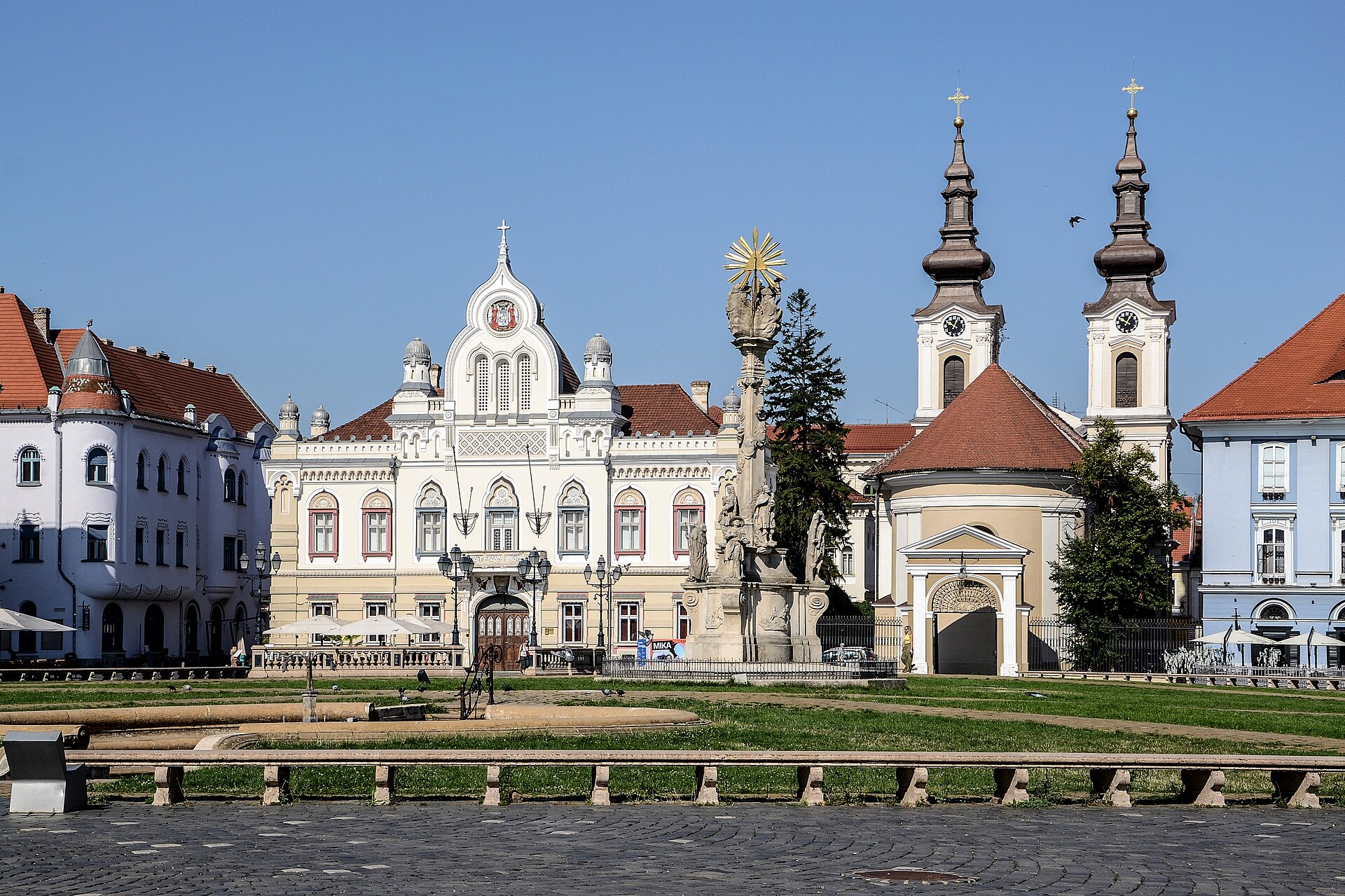
Timișoara (German: Temeschburg, Hungarian: Temesvár) is Romania's most cosmopolitan city — a graceful, pastel-hued metropolis of Baroque palaces, Vienna Secession facades, and leafy parks that earned it the nicknames "Little Vienna" (Mica Vienă) and "City of Parks." With a population of ~320,000, it is the capital of Banat and the largest city in western Romania. In 2023, Timișoara became the first Romanian city to hold the title of European Capital of Culture — a crown it wears beautifully, with a legacy of street art, festivals, and revitalised public spaces.
🗓 Best Time to Visit
April–October is the sweet spot. May and June are glorious — the Rose Park (Parcul Rozelor) explodes into bloom with 1,200 varieties of roses, and cafe terraces fill every square. September–October offers mild temperatures and golden light catching the Secession facades — ideal for photography. July–August can reach 35°C+, but the city's many parks, the Bega canal promenade, and air-conditioned museums provide relief; this is also when the Timișoara Jazz Festival (July) and various street art and music events — legacy programming from the 2023 Capital of Culture — are at their peak. Winter (December–February) is cold (0°C to −5°C) but the Christmas market on Victory Square is charming, with mulled wine, local crafts, and carousel rides. Indoor attractions (museums, the Opera, cafes) are excellent year-round. Timișoara sees far fewer tourists than nearby Budapest or Belgrade, so you rarely fight crowds regardless of season.
🍽 Food & Drink — Where to Eat
Timișoara's dining scene is the finest in western Romania — a sophisticated blend of fine dining, Italian influence from the nearby border, and hearty Banat cuisine built on local produce. Restaurant Merlot (Strada Gheorghe Lazăr 2, mains 55–120 RON, tasting menu ~200 RON) is the city's top fine-dining destination, housed in an intimate brick-vaulted cellar near Opera Square. The menu showcases modern Romanian dishes with French technique — grilled local meats, freshwater fish from the Banat region, and an extensive wine list featuring Romanian labels (the restaurant's name pays homage to the varietal). Service is impeccable and the atmosphere is hushed and romantic. Locanda Del Corso (Strada Alba Iulia 2, Union Square, pizza 35–55 RON, pasta 40–70 RON, mains 50–90 RON) is considered the best Italian restaurant in the city — handmade pasta, wood-fired pizza, excellent tiramisu, and a terrace overlooking the Baroque Palace and the Roman Catholic Dome. The tagliatelle al tartufo (65 RON) and the pizza prosciutto e rucola (48 RON) are local favourites. Mărul Cuțui (Strada Lucian Blaga 9, mains 40–80 RON) is a charming farm-to-table spot in a converted townhouse, serving seasonal Banat cuisine — wild mushroom stew, duck confit with sour cherries, local cheeses, and house-made bread, all sourced from nearby farms. The name translates to "Cutui Apple," a traditional Romanian heirloom variety. Neata (Strada Proclamația de la Timișoara 1, mains 50–100 RON) offers modern Romanian cuisine in a sleek setting — think venison loin with blackberry sauce and polenta crisps, or trout with hazelnut brown butter. Casa Bunicii (25–50 RON) is the budget-friendly favourite — a grandma-style restaurant serving sarmale (cabbage rolls, 18 RON), mici (grilled minced meat rolls, 15 RON), mămăligă (polenta), and ciorbă de burtă (tripe soup, 12 RON) in a homey setting. La Pizza Napoletana (30–50 RON) serves authentic Neapolitan pizza — the Margherita DOP at 32 RON is outstanding. Restaurant Pescărușul (mains 50–90 RON) is the top seafood choice, dining on the Bega River. For coffee, Atelier (specialty brunch, 15–35 RON) and Kafka Cafe on Union Square (pies and coffee, 20–40 RON) serve excellent third-wave coffee (10–18 RON). Try bere Timișoreana, the local beer brewed since 1718 — Romania's oldest beer brand, smooth and refreshing.
🚗 How to Get to Timișoara by Bus, Car & Boat
Timișoara's Traian Vuia International Airport (TSR) has direct flights from London (Wizz Air, Ryanair), Munich (Lufthansa), Vienna, Rome, Milan, Bucharest, and Istanbul — it is the main gateway for western Romania. By train: CFR InterRegio trains connect Timișoara to Bucharest (6–7 hours, 100–140 RON), Cluj-Napoca (4.5 hours, 70–90 RON), Arad (45 min, 20 RON), and Oradea (2 hours). The main station (Gara de Nord) is a 20-minute walk north of Victory Square. By car: From Budapest via the M43/A1 highway — 3 hours from Budapest city centre, making this the easiest land border crossing from Hungary. Parking in the centre is limited; use the parking garages on Strada Corbului and Strada Mihai Eminescu (5 RON/hour). Getting around: The historic centre is compact — all three squares and most museums are within a 15-minute walk. The city has 9 tram lines, ~30 bus routes, and trolleybuses (single ticket 4 RON from ticket machines, day pass 12 RON). Uber and Bolt are abundant and cheap (5–15 RON for centre rides). Electric boat rentals on the Bega Canal (20–30 RON per person for a 45-minute ride) offer a unique perspective of the city from the water — best at sunset when the Secession buildings glow gold.
🥘 Where to Eat in Timișoara: Authentic Local Cuisine
Timișoara's dining scene is the finest in western Romania — a sophisticated blend of fine dining, Italian influence from the nearby border, and hearty Banat cuisine built on local produce. Restaurant Merlot (Strada Gheorghe Lazăr 2, mains 55–120 RON, tasting menu ~200 RON) is the city's top fine-dining destination, housed in an intimate brick-vaulted cellar near Opera Square. The menu showcases modern Romanian dishes with French technique — grilled local meats, freshwater fish from the Banat region, and an extensive wine list featuring Romanian labels (the restaurant's name pays homage to the varietal). Service is impeccable and the atmosphere is hushed and romantic. Locanda Del Corso (Strada Alba Iulia 2, Union Square, pizza 35–55 RON, pasta 40–70 RON, mains 50–90 RON) is considered the best Italian restaurant in the city — handmade pasta, wood-fired pizza, excellent tiramisu, and a terrace overlooking the Baroque Palace and the Roman Catholic Dome. The tagliatelle al tartufo (65 RON) and the pizza prosciutto e rucola (48 RON) are local favourites. Mărul Cuțui (Strada Lucian Blaga 9, mains 40–80 RON) is a charming farm-to-table spot in a converted townhouse, serving seasonal Banat cuisine — wild mushroom stew, duck confit with sour cherries, local cheeses, and house-made bread, all sourced from nearby farms. The name translates to "Cutui Apple," a traditional Romanian heirloom variety. Neata (Strada Proclamația de la Timișoara 1, mains 50–100 RON) offers modern Romanian cuisine in a sleek setting — think venison loin with blackberry sauce and polenta crisps, or trout with hazelnut brown butter. Casa Bunicii (25–50 RON) is the budget-friendly favourite — a grandma-style restaurant serving sarmale (cabbage rolls, 18 RON), mici (grilled minced meat rolls, 15 RON), mămăligă (polenta), and ciorbă de burtă (tripe soup, 12 RON) in a homey setting. La Pizza Napoletana (30–50 RON) serves authentic Neapolitan pizza — the Margherita DOP at 32 RON is outstanding. Restaurant Pescărușul (mains 50–90 RON) is the top seafood choice, dining on the Bega River. For coffee, Atelier (specialty brunch, 15–35 RON) and Kafka Cafe on Union Square (pies and coffee, 20–40 RON) serve excellent third-wave coffee (10–18 RON). Try bere Timișoreana, the local beer brewed since 1718 — Romania's oldest beer brand, smooth and refreshing.
🏨 Where to Stay in Timișoara
The best area to stay is around Union Square or Victory Square, where you are steps from everything. Hotel Timișoara (400–700 RON/night) is the city's premier 5-star hotel with a rooftop pool, spa, and the excellent Merlot restaurant. NH Timișoara (350–600 RON/night) is a sleek modern hotel on the Bega Canal. Hotel Imperial (300–500 RON) is a beautifully restored early 20th-century building on Victory Square with high-ceilinged rooms and a central location. Hotel Decebal (200–350 RON) offers modern, clean rooms near Union Square at mid-range prices. North Star Hostel (55–90 RON/dorm, 180–250 RON/private) is the backpacker pick near the train station. For a unique experience, Bruckenblick Apartments (250–400 RON) are modern studios overlooking the Bega Canal. Airbnb options in the historic centre are plentiful: budget apartments from 200 RON/night, central doubles typically 200–400 RON/night. Timișoara is slightly more expensive than other Romanian cities due to its Capital of Culture lift, but still exceptional value by EU standards.
Find a stay in Timișoara
Compare apartments, guesthouses, and vacation rentals while you finalize your route. Flexible cancellation can help when drive times or border plans change.
Browse stays in Timișoara on Vrbo →📸 Photo timing: The best Zsolnay ceramic tile roofs are on the Brück House and Palace of Culture — shoot in late afternoon (17:00–18:30 in summer) when the low sun makes the iridescent green-and-gold glaze glow. 🏛 Revolution museum strategy: It's small but emotionally intense — allow 45 minutes to an hour. Go in the morning before the crowds, and take a guided tour (25 RON, English available on request) for the most powerful experience. The Martyrs' Cemetery (Cimitirul Eroilor) is a short walk from the centre and deeply moving. 🌅 Sunset on the Bega: The 20:00 boat cruise in summer catches the golden hour on the Secession facades along the canal — this is the most romantic thing to do in the city. 🎭 Opera bargain: Balcony tickets at the Timișoara National Opera start at just 30 RON — check the program and dress up for a night out. 🚶 Free walking tour: The three squares — Victory, Union, Liberty — can all be walked in a relaxed loop in under an hour. Start at Victory Square, walk through Union Square, detour to Liberty, then back along the Bega canal. ☕ Best coffee spots: Atelier (specialty brunch) and Kafka Cafe (Union Square terrace) are the top choices. 🏺 Souvenirs: Skip mass-produced trinkets and buy hand-painted Zsolnay-style ceramic tiles at the Union Square artisan market (weekends, 25–50 RON) or local Banat honey from the farmers' market. 🌳 Park escape: The Rose Park (1,200 varieties) is free and glorious in May–June. Rosa Park and the Botanical Park are quieter alternatives. 🇭🇺 Day trip: Hungary's border is 30 minutes away — Arad (45 min by train, 20 RON) makes an easy half-day excursion with its neo-classical architecture and Union Square.
Hidden Gems in Timișoara
- Spend time in Liberty Square, the smaller and quieter of the city’s three central squares, with its Old Town Hall and residential atmosphere.
- Follow the Bega Canal away from the main squares for a slower city perspective, or take an electric boat at sunset.
- Rose Park rewards a visit in May and June, when its 1,200 rose varieties are in bloom.
Accessibility
- The historic centre is compact, with the three main squares and most museums within a 15-minute walk.
- Central squares and promenades are easier than many historic interiors, whose access varies.
- Confirm step-free entry at museums, churches, and the Opera.
- Use public transport or taxis when walking distances or heat make a full day tiring.
Common Mistakes
- Trying to see every square and museum in one rushed day.
- Assuming every historic palace has a modern entrance.
- Walking exposed squares during the hottest hours.
- Missing the parks and Bega promenade while staying only in the centre.
Photography
- Use Secession façades and broad squares as architectural anchors.
- Photograph Rose Park in soft light.
- Use the Bega Canal to add a quieter line through the city.
- Romania regulates drones — check current registration and flight rules with the Romanian Civil Aeronautical Authority (AACR) before flying.
Etiquette
- Ask before photographing people.
- Dress modestly in churches.
- Follow museum and Opera rules.
- Keep paths clear in parks.
- Respect residential entrances.
Frequently Asked Questions
How did the 1989 Romanian Revolution start in Timișoara?
The 1989 Romanian Revolution began in Timișoara on December 16, 1989. Hungarian Reformed pastor László Tőkés was threatened with eviction by the Securitate; his congregation formed a human chain around his church. Protests escalated into a mass uprising. On December 17 (Bloody Sunday), Ceaușescu ordered a military crackdown — soldiers opened fire, killing an estimated 89–110+ civilians. Timișoara was declared the first city free of Ceaușescu's rule on December 20. The revolution spread to Bucharest on December 21–22, culminating in Ceaușescu's overthrow and execution on December 25. The Revolution Memorial Museum (10–15 RON) documents these events.
What was Timișoara's role in electric street lighting history?
On November 12, 1884, Timișoara became the first city in continental Europe with electric street lighting — 731 lamps powered by a hydroelectric plant on the Bega River, installed by Siemens. This earned Timișoara the nickname 'Little Vienna.' The city also introduced the first horse-drawn tram in Romania (1869), the first telephone exchange (1881), and the first film screening in Romania (1895). A memorial plaque on the Prefecture Building in Victory Square commemorates the first electric lighting.
What are the three main squares of Timișoara?
Victory Square (Piața Victoriei) is the long pedestrian promenade anchored by the Metropolitan Orthodox Cathedral and the Opera House — the vibrant heart and the epicenter of the 1989 Revolution. Union Square (Piața Unirii) is the oldest square, with the Baroque Palace, the Roman Catholic Dome, and the Serbian Orthodox Cathedral facing each other across a harmonious blend of Baroque and Secession architecture. Liberty Square (Piața Libertății) is smaller and quieter, with the photogenic Old Town Hall and a relaxed, residential atmosphere. All three are within a 5–10 minute walk of each other.
What is the mid-range daily budget for Timișoara?
A comfortable mid-range daily budget in Timișoara runs about 200–400 RON per person (€40–80). This covers: 2–3 museum entries (40–60 RON total), lunch at Casa Bunicii (25–50 RON), dinner at Mărul Cuțui or Locanda Del Corso (40–90 RON), local transport (4–12 RON), and specialty coffee (10–18 RON). Accommodation is extra: hostel dorms 50–80 RON/night, mid-range hotel doubles 250–450 RON/night, boutique hotels 350–600 RON/night.
What is Zsolnay ceramic and where can I see it in Timișoara?
Zsolnay is a Hungarian porcelain manufacturer from Pécs, famous for its iridescent eosin-glazed ceramic roof tiles in green, gold, and turquoise. In Timișoara, Zsolnay tiles crown Secession buildings across the city — notably the Brück House (Union Square), the Neuhaus Palace, the Palace of Culture, and the Mercy Palace. The signature glazed roofs are a defining feature of the city's architectural identity, especially visible on Union Square and along Strada Alba Iulia.
What are the entry fees for Timișoara's main attractions?
Union Square is FREE to enter year-round. Revolution Memorial Museum: 10–15 RON (guided tours 25 RON). Huniade Castle / Museum of Banat: 15–20 RON (students 5 RON, seniors 7.5 RON). Art Museum in the Baroque Palace: 15 RON. Banat Village Museum: 10 RON. Metropolitan Orthodox Cathedral: FREE (donations welcome). Bega River boat cruise: 20–30 RON. Timișoara Opera balcony tickets: 30–80 RON. Zoo: 12 RON adults, 6 RON children.
What are the best restaurants in Timișoara and how much do they cost?
Merlot (mains 55–120 RON) is the city's top fine-dining destination, with a brick-vaulted cellar and extensive Romanian wine list. Locanda Del Corso (pizza 35–55 RON, pasta 40–70 RON, mains 50–90 RON) serves authentic Italian on Union Square with terrace views. Mărul Cuțui (mains 40–80 RON) is a farm-to-table gem serving seasonal Banat cuisine. Neata (mains 50–100 RON) offers modern Romanian dishes. Casa Bunicii (25–50 RON) is budget-friendly grandma-style cooking — sarmale, mici, and ciorbă. La Pizza Napoletana (30–50 RON) serves authentic Neapolitan pizza. Kafka Cafe and Atelier serve excellent coffee (10–18 RON).
🗺️ Build a route around Timișoara: Add Timișoara to my itinerary. It opens the planner with this stop selected, so you can add nearby places and set the trip length.
Plan your budget
For country-level budget ranges and planning assumptions, see the Balkan travel costs guide.